Why go
A modern city with Soussi roots
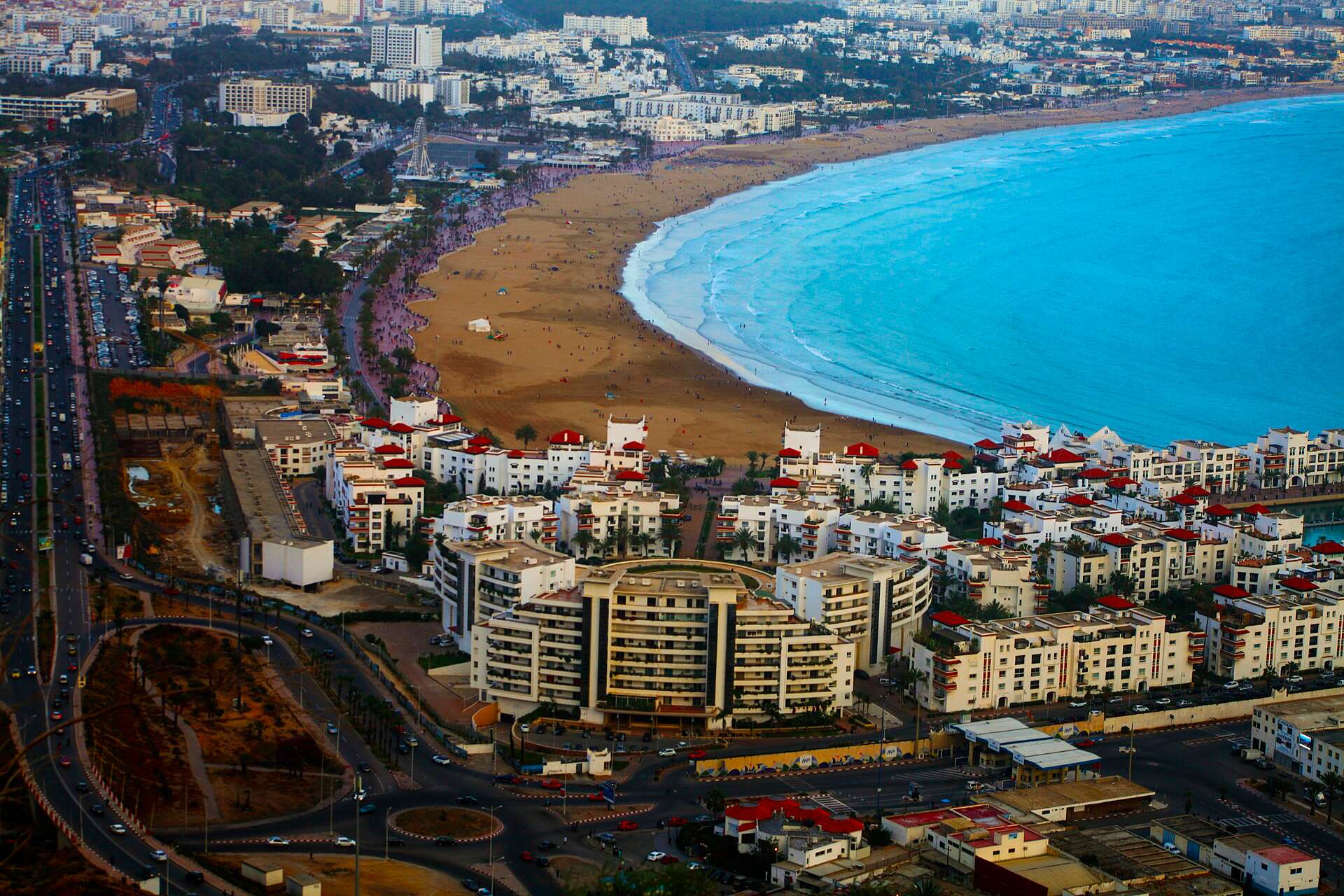
After the great earthquake that flattened it in the last century, Agadir was rebuilt almost entirely: wide avenues, low-rise buildings and a seafront promenade made for walking. The old part is on the hill, at the Agadir Oufella kasbah, whose slope bears the country's motto written in Arabic: God, Country, King.
It is the capital of the Souss, an Amazigh region where Tashelhit is heard alongside Darija, a land of argan, honey and market gardens. Locals know their city by its port, Souk El Had and family afternoons on the beach, more than by the hotels along the seafront.
Sea, surf and mountains close at hand
To the north, the coast turns rocky and the surf villages begin, led by Taghazout. Inland, Paradise Valley hides rock pools and palm trees. Further afield lie Taroudant and Tiznit, both walled towns, and Essaouira, a medina listed as a World Heritage Site since 2001.
Spanish is spoken in the south too
The Moroccan tourist office notes that Spanish is widely spoken in the north and south of the country, and the Instituto Cervantes highlights Spanish teaching at university level in Agadir, where it has a branch. Even so, a few words of Darija open doors: see Spanish, French and Darija.
What to see in 1, 2 and 3 days
Day 1 · The bay and the kasbah
- Morning on Agadir beach and its promenade; swim in supervised areas, as the Atlantic has currents.
- A break in the shade of the Vallée des Oiseaux, a small park right in the centre.
- Grilled fish by the fishing port, the economic heart of the city.
- A stroll through Talborjt, a neighbourhood of cafés and local life.
- Sunset at Agadir Oufella, with the whole bay at your feet.
Day 2 · Souk El Had and Taghazout
- Morning at Souk El Had: Souss fruit, spices, argan oil and crafts.
- Bring dirhams in cash; we explain why in money and payments.
- With children, Crocoparc, on the outskirts, is an easy visit.
- In the afternoon, Taghazout: a fishing village turned surf mecca, with schools for beginners.
- Sunset and dinner by the sea before heading back.
Day 3 · Paradise Valley or the interior
- Early on, Paradise Valley: rock pools, palm trees and stone. Wear shoes with grip and bring water.
- Alternative: Tiznit, a walled town famous for its Amazigh silverwork.
- Or Taroudant and its earthen walls; first, check Spain's Foreign Ministry, which in November 2026 advised against travel to Taroudant province, hit by the earthquake.
- With more time, Essaouira deserves a night of its own.
- A last walk along the bay at sunset, when the beach fills with families.
What to eat in Agadir
Agadir eats with a view of the sea: by the port you pick the catch of the day and have it grilled, with the sardine as queen, and fish tagine is the local take on the national dish. The Souss contributes amlou, a spread of almonds, argan oil and honey for breakfast bread, and argan in the kitchen. Friday couscous, msemen and mint tea complete the table.
As everywhere in the country, Spain's Foreign Ministry recommends bottled water, well-washed fruit and avoiding salads in summer.
Where to stay in Agadir
Almost everything revolves around the bay. The centre to experience the city, the seafront for the sea, Taghazout if you are coming to surf.
Budget
Simple hotels and apartments in Talborjt or near Souk El Had, with neighbourhood restaurants close by.
Mid-range
Hotels and apartments a few streets back from the promenade, or surf guesthouses in Taghazout.
Splurge
Hotels with pools right on the bay, or the quieter resorts around Taghazout.
Affiliate link: if you book through it we earn a commission, at no extra cost to you. How we are funded
Getting around and avoiding scams
Getting around Agadir
The centre and the bay are easy on foot. For everything else, a petit taxi with the meter, which is compulsory: ask the driver to switch it on or agree the fare first. For Taghazout or Inezgane there are shared grands taxis.
For the interior, a hire car gives you freedom: read driving in Morocco. Ride-hailing apps work, but the UK Foreign Office warns that many such cars are unlicensed.
Weather and sea
One of the mildest summers among the host cities: averages of 25.6 °C for the high and 18.1 °C for the low in June, and 26.7 and 19.2 °C in July. The sun is still strong: sun cream, a cap and water.
The UK Foreign Office warns of strong currents and unexpected waves, and that many beaches have little or no supervision. Inland, the heat climbs quickly: more in weather in June and July.
Safety and well-known scams
Agadir is calm, but petty theft is common in medinas and on beaches: don't leave your phone on your towel. In tourist areas, fake guides appear who steer you to shops for a commission; the UK Foreign Office recommends checking their accreditation and the permit from the local authority.
Impromptu henna is another well-known practice: someone starts drawing on you without asking and then demands money. Say no clearly, or agree the price first. More in customs and tipping.
The Grand Stade d'Agadir (Adrar)
- Name
- Gran Estadio de Agadir (Adrar)
- Capacity
- 41,800
- Planned capacity for 2030
- 46,000
- Status
- Being renovated
- Distance from the centre
- 9.3 km14 min by car, without traffic
The Grand Stade d'Agadir, or Adrar stadium, opened on 11 October 2013 in Hay Mohammadi, on a 32-hectare site. It is 9.3 km from the centre, 14 minutes without traffic by our calculation; the Moroccan government portal says 15 minutes from the centre and 30 from the airport.
It has 41,800 seats, with 46,000 planned for 2030. The first phase, for the 2025 Africa Cup of Nations, expanded parking from 2,600 to 4,100 spaces and renewed the pitch and changing rooms. The second, from 2026 to 2028, plans a full 360° roof, enlarged stands and VIP areas.
The match schedule and how matches are shared between cities have not been announced. There are no confirmed shuttles: count on a taxi or car and sort out your return before the match.
The match schedule has not been published yet. When it is announced, we will cover it here without speculation.
Getting there from Spain
By air
Agadir-Al Massira (AGA) has direct flights with Ryanair from Madrid and Tenerife Sur, Binter from Gran Canaria and Vueling from Barcelona in season. Royal Air Maroc sells Málaga and Madrid without specifying whether they are direct. Routes change with the season.
Another option is to fly to Marrakesh, which has many more routes, and continue by bus: Agadir has no railway, but Supratours buses leave from beside Marrakesh station roughly every hour and take about 3 h 30. High-speed rail to Agadir is only at the study stage, with no date. See Marrakesh and Agadir in a week and the Marrakesh page.
Frequently asked questions
How do you get to Agadir from Spain?
By direct flight from Madrid, Tenerife Sur, Gran Canaria or Barcelona (in season), or by flying to Marrakesh and continuing on a Supratours bus, about 3 h 30. By car, via Algeciras and Tanger Med in several stages: see Crossing the Strait and the road trip from Algeciras.
Is there a train to Agadir?
No. The usual option is the Supratours bus from Marrakesh, roughly every hour, taking about 3 h 30.
Is Agadir hot in July?
Less than inland: the average high is 26.7 °C and the average low 19.2 °C, thanks to the Atlantic.
Can you combine Agadir and Marrakesh?
Yes, and it is one of the easiest combinations in the country. We suggest a plan in Marrakesh and Agadir in a week.
How many 2030 World Cup matches will Agadir host?
Nobody knows yet. The schedule and how matches are shared between cities have not been announced, and the final list of stadiums was still pending in November 2026.
Sources (8)
Every fact on this page comes from a source consulted on the date shown.
- Hespress · después de 2026, Marruecos toma el relevo (julio de 2026) (press), 2026-11-12
- Royal Air Maroc · vuelos a España, 2026-11-12
- Seat61 · train travel in Morocco (press), 2026-11-12
- OSRM (OpenStreetMap), cálculo del 12-11-2026, 2026-11-12
- Wikipedia · List of World Heritage Sites in Morocco (press), 2026-11-12
- Seat61 · train travel in Morocco (press), 2026-11-12
- Wikipedia · Agadir-Al Massira Airport (press), 2026-11-12
- Visit Morocco · Agadir-Taghazout, 2026-11-12