Why go
A living medina, not a stage set
Fez el-Bali, the old medina, is explored on foot: its alleys carry mules and handcarts rather than cars, and when you hear “balak!” it is time to flatten yourself against the wall. Behind every door there is a workshop, a neighbourhood bakery or a family home. It works for its residents before it works for visitors, and that is exactly why it is so striking.
Fez is Morocco's benchmark for religious learning and craftsmanship. This is home to the Qarawiyyin, founded by a woman, Fatima al-Fihri. And Fassi cooking has a reputation as the most refined in the country: any Moroccan will tell you so.
Three cities in one
The city makes more sense as three cities side by side, each from a different era.
- Fez el-Bali: the old medina, with Bab Boujloud as its great entrance gate.
- Fez el-Jdid: the Marinid city, with the Mellah, the former Jewish quarter, and the gates of the royal palace.
- The Ville Nouvelle: avenues, cafés, the railway station and everyday Fez.
The inland host
It is the only Moroccan host city far from the sea, and in summer you feel it. In return, it is the gateway to Meknes and Volubilis, and it is within easy reach if you drive down from the north (road trip from Algeciras). Football here means MAS, the city's club.
What to see in 1, 2 and 3 days
Day 1 · Fez el-Bali
- Enter through Bab Boujloud, the blue gate, first thing in the morning.
- Walk down the Talaa Kebira to the Bou Inania Madrasa and the Al Attarine Madrasa.
- Around the Qarawiyyin: it is a working mosque, so don't go through any door without asking.
- The Nejjarine museum, devoted to woodwork.
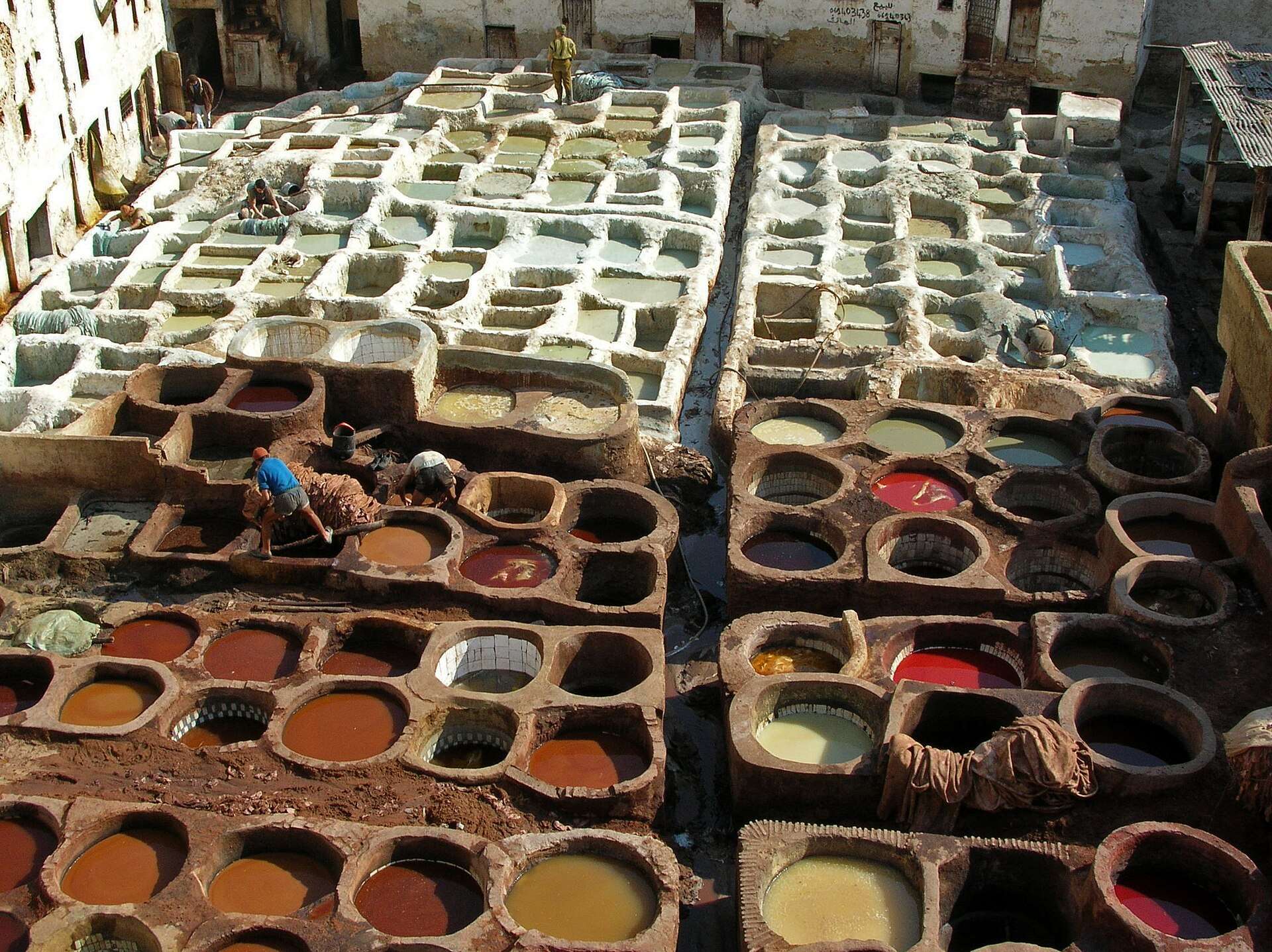
- The tanneries from a rooftop: you will be invited up in exchange for passing through the shop; looking doesn't oblige you to buy.
Day 2 · Fez el-Jdid and the heights
- Morning in the shade of the Jnan Sbil garden.
- Fez el-Jdid: the Mellah and the monumental gates of the royal palace.
- Lunch in the Ville Nouvelle.
- At sunset, the Marinid tombs: the best view of the medina.
Day 3 · Meknes and Volubilis
- Leave early for Meknes, an imperial city and World Heritage Site since 1996, by train or car.
- Bab Mansour and Place el-Hedim, the heart of its medina.
- Volubilis, Roman ruins inscribed in 1997, with open-air mosaics: bring water and a cap, as there is little shade.
- A stop at Moulay Idriss Zerhoun, the holy town on the neighbouring hill.
- Back to Fez for dinner.
What to eat in Fez
Fassi pastilla is the festive dish: fine pastry filled with pigeon or chicken, almonds and cinnamon, dusted with sugar. That interplay of sweet and savoury runs through the city's cooking, from tagines with prunes to almond and honey pastries.
For breakfast, bissara, a broad bean soup with olive oil and cumin, from the medina stalls, or khlii, preserved meat fried with eggs. Alcohol is only served in licensed premises, almost always outside the medina. Bottled water and well-washed fruit.
- Pigeon or chicken pastilla.
- Bissara.
- Khlii with eggs.
- Meat tagine with prunes and almonds.
- Mint tea with chebakia.
Where to stay in Fez
A riad in the medina is part of the experience; ask to be met at a gate and accept the porter for your luggage. For the stadium and the train, the Ville Nouvelle is more practical.
Budget
Hostels and simple riads near Bab Boujloud, with taxis close at hand. Small rooms and a shared terrace.
Mid-range
Restored riads in Fez el-Bali, with a courtyard and breakfast on the terrace, or modern hotels near the station.
Top end
Former mansions turned into riads, and hotels on the edge of the medina, with a pool and views over the rooftops.
Affiliate link: if you book through it we earn a commission, at no extra cost to you. How we are funded
Getting around and avoiding scams
Getting around: on foot in the medina, taxi outside
Inside Fez el-Bali you can only walk, and GPS gets lost between the high walls: keep track of the main streets and the gates, and ask in a shop if you lose your way. For the Ville Nouvelle or the station, a petit taxi with the meter running, which the law requires; for Meknes or Volubilis, a grand taxi or the train.
Almost everyone understands French, and a few words of Darija open doors (Spanish, French and Darija).
Fake guides and other scams
It is the Fez classic: someone tells you the street is closed or the tannery is the other way, and you end up in a shop that pays them a commission. Working as a guide without a licence is illegal; an authorised guide carries a badge and a permit from the local authority. If you want a guide, ask at your riad.
There are pickpockets in the medina: keep your bag closed and in front of you. Even so, Morocco is, in general terms, a safe country for travellers, according to Spain's Foreign Ministry. More in customs and tipping.
Heat and the rhythm of the day
Summer is hot: 14.9 to 31.2 °C in June and 17.9 to 35.1 °C in July (1991-2020 normals). Do as the Fassis do: out in the morning and at dusk, in the shade at midday (weather in June and July). In the medina cards are of little use: carry dirhams (money and payments).
The Fez Sports Complex
- Name
- Complejo Deportivo de Fez
- Capacity
- 35,000
- Status
- Being renovated
- Distance from the centre
- 6.9 km10 min by car, without traffic
The stadium was renovated in 13 months and reopened in June 2025 with 35,000 seats. It is 6.9 km from the centre, about 10 minutes by road without traffic according to our calculation.
In August 2026 a second phase of works worth 2,816 million dirhams went out to tender. Capacity for 2030 is not confirmed: the published figures do not match.
The transport plan of July 2024 provides for 420 shuttles to the stadium and 40 to the airport on match days; no tram is planned. The final list of stadiums and the allocation of matches by city have not been announced.
The match schedule has not been published yet. When it is announced, we will cover it here without speculation.
Getting there from Spain
By air
Fès-Saïss airport (FEZ) is served by Ryanair from Barcelona, Madrid and Málaga, and in season from Alicante and Valencia; Air Arabia Maroc from Barcelona; and Binter from Gran Canaria, in season. Routes change with the season: check them before you book.
Fez has no Al Boraq: from Tangier, take the high-speed train to Kenitra and then a classic train (Al Boraq and ONCF).
Frequently asked questions
How many days do you need in Fez?
Two for Fez el-Bali, Fez el-Jdid and the Marinid tombs; a third for Meknes and Volubilis.
Do you need a guide for the medina?
It isn't compulsory, but it helps on the first day. Book one through your accommodation, with a badge and a permit from the local authority.
Can you get to Fez by train from Tangier?
Yes: the Al Boraq to Kenitra and then a classic train.
What capacity will the Fez stadium have in 2030?
It is not confirmed. Today it holds 35,000, and a second phase of works went out to tender in August 2026.
Which matches will be played in Fez?
Nobody knows yet: the schedule and the allocation by city have not been announced.
Sources (8)
Every fact on this page comes from a source consulted on the date shown.
- Hespress · después de 2026, Marruecos toma el relevo (julio de 2026) (press), 2026-11-12
- Royal Air Maroc · vuelos a España, 2026-11-12
- Seat61 · train travel in Morocco (press), 2026-11-12
- OSRM (OpenStreetMap), cálculo del 12-11-2026, 2026-11-12
- Wikipedia · List of World Heritage Sites in Morocco (press), 2026-11-12
- Wikipedia · Fès-Saïss Airport (press), 2026-11-12
- Le360 · cómo se prepara Fez (press), 2026-11-12
- Visit Morocco · Fez, 2026-11-12