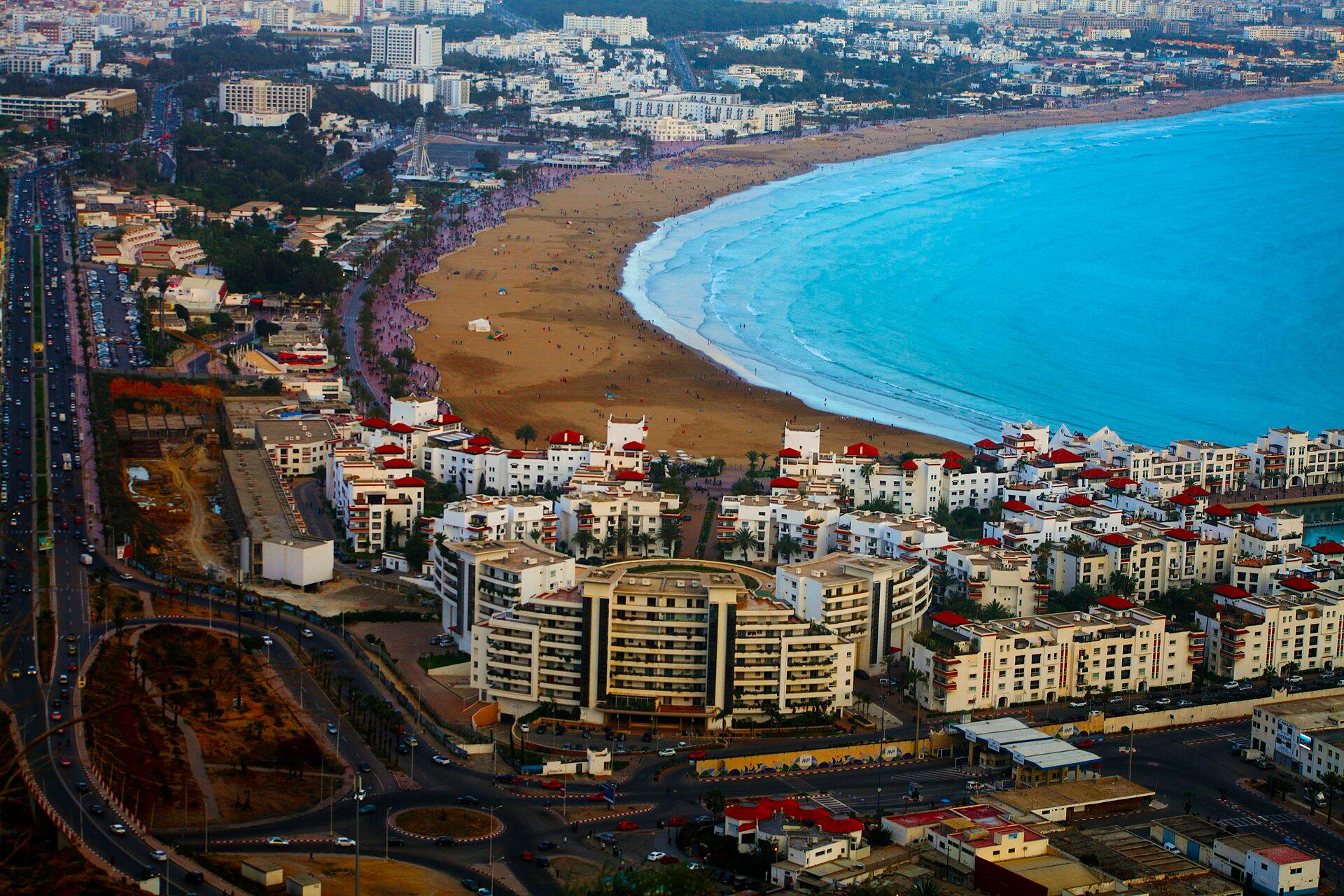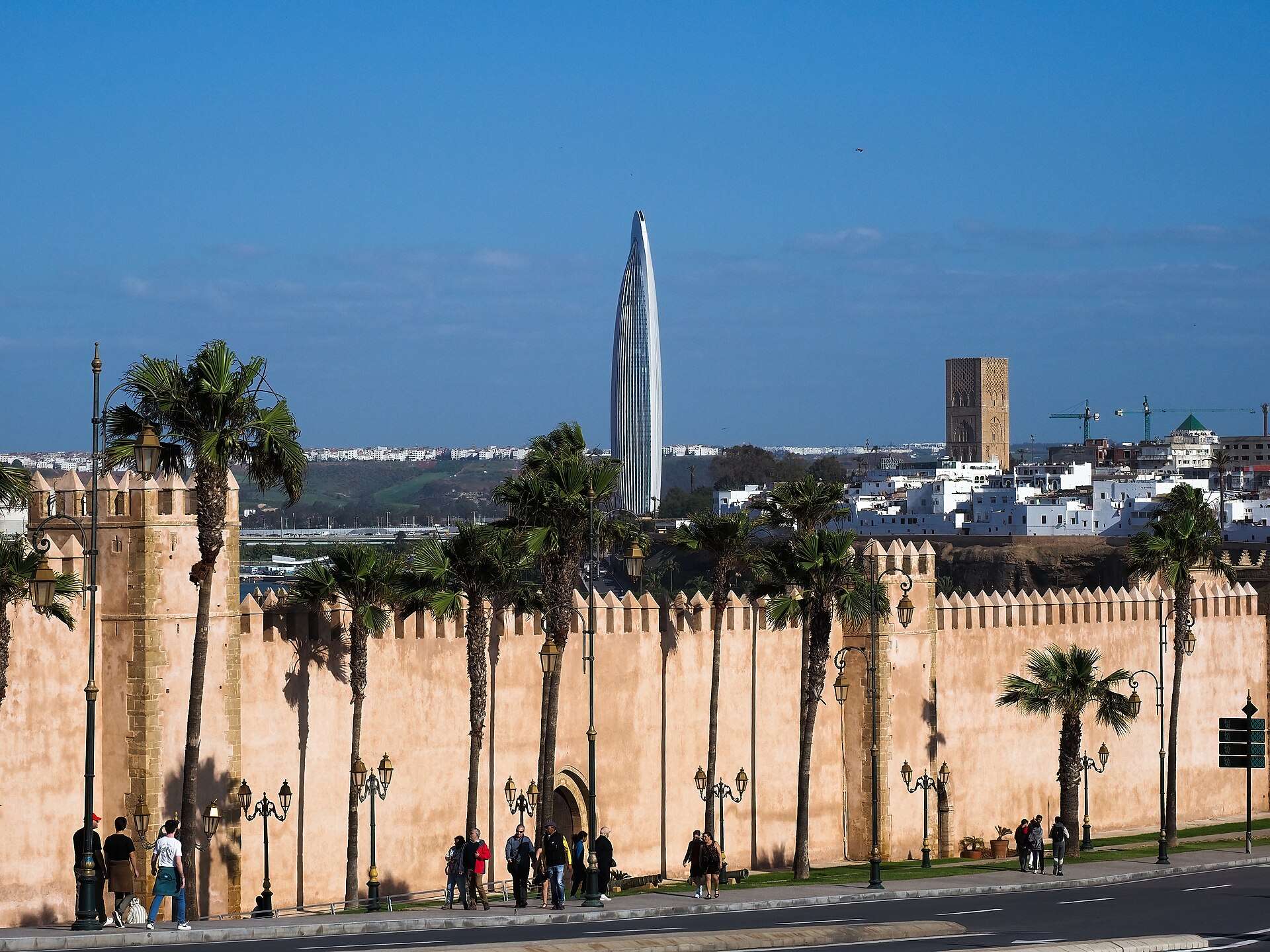
Why go
Why go to Rabat
Rabat tends to sit in the shadow of Marrakesh or Fez, which is a shame. It is the capital, home to the royal palace, the ministries and the embassies, and an easy city: green, orderly and more laid-back than Casablanca. Since 2012 it has been a World Heritage Site as a “modern capital and historic city”, a shared heritage that brings together the medina, the kasbah and the city laid out in the 20th century.
For anyone arriving via the Strait it is a logical stop: the Al Boraq links Tanger Ville with Rabat Agdal and continues to Casa Voyageurs. We cover it in the itinerary Tangier, Rabat and Casablanca by train.
Atmosphere: an everyday capital
Rabat is a city of civil servants, students and families. In the evening people stroll along the river and the corniche; at weekends the gardens and the beach fill up. It does not live off tourism, and it shows: in the medina people shop for their homes, not for visitors.
Opposite, across the Bou Regreg, lies Salé, about 10 minutes away: a different city, with its own medina and a strong identity. French and Arabic share every street corner; Spanish is heard less than in the north, although there is an Instituto Cervantes. A few words of Darija help: Spanish, French and Darija.
Neighbourhoods to get your bearings
The historic city clusters by the river and the sea; the new city spreads south.
- Udayas: the kasbah above the river mouth, with Andalusian gardens.
- Medina: compact, between the walls and the river, with the Rue des Consuls.
- New city: Avenue Mohammed V, Parliament and 20th-century façades.
- Hassan: the Hassan Tower and the Mausoleum of Mohammed V.
- Agdal: residential and studenty, with the Al Boraq station.
- Salé: the far bank, linked by tram.
What to see in 1, 2 and 3 days
Day 1 · Udayas, medina and Hassan Tower
- Early on, the Kasbah of the Udayas through its great Almohad gate.
- Tea and pastries on the terrace of the Andalusian gardens, looking across to Salé.
- The medina along the Rue des Consuls, among carpets and crafts.
- In the afternoon, the Hassan Tower, an unfinished 12th-century minaret, and the Mausoleum of Mohammed V.
- Sunset on the banks of the Bou Regreg.
Day 2 · Chellah, new city and museums
- The Chellah, a Marinid necropolis on Roman ruins, with storks on the walls.
- Avenue Mohammed V: Parliament, 1920s and 1930s façades, cafés.
- The Mohammed VI Museum of Modern and Contemporary Art.
- Afternoon and dinner in Agdal.
Day 3 · Salé and the coast
- Tram to the Gare de Salé stop.
- The Salé medina, its Great Mosque and the Marinid madrasa.
- The Exotic Gardens of Bouknadel, north of Salé along the coast.
- Back via the Bou Regreg marina, with the kasbah opposite.
- Alternative: the high-speed train to Casablanca.
What to eat in Rabat
Rabat eats well and without fuss, with a strong Andalusi heritage: chicken or pigeon pastilla, rfissa with lentils and fenugreek, lamb tagine with prunes and the couscous many families make on Fridays. For breakfast, msemen, baghrir with honey or freshly fried sfenj.
The cheapest food is in the medina: fried fish, soups, sandwiches. Agdal and the new city have family restaurants, patisseries and terraces; the marina has river views; the Udayas serve the prettiest tea in town. Alcohol is only served in licensed premises. For paying and tipping, see money and payments.
Where to stay in Rabat
Less tourist accommodation than Marrakesh, plenty of business hotels. Look near the tram or Rabat Agdal if you are arriving on the Al Boraq, and book with free cancellation: the match schedule has not yet been announced.
Budget
Hostels and simple riads in the medina, near the Udayas, or modest hotels near Avenue Mohammed V and Rabat Ville.
Mid-range
Restored riads with a terrace in the medina, or city hotels in Agdal, close to the tram and the high-speed train.
Top end
Large hotels in Hassan, Souissi or the Bou Regreg marina, with a pool and parking: handy for driving to the stadium.
Affiliate link: if you book through it we earn a commission, at no extra cost to you. How we are funded
Getting around and avoiding scams
Getting around Rabat
The tram links Rabat and Salé, with stops including Agdal-Avenue de France, Rabat Ville station and Gare de Salé. Petits taxis are blue, only operate within the city and must use the meter: without one it is illegal. inDrive, Careem, Yango and Yassir operate here within an incomplete legal framework, and the British government warns that many of these cars are unlicensed.
Watch the station names: the Al Boraq stops at Rabat Agdal; Rabat Ville only has classic trains. Details in the train guide.
Safety and scams
Rabat has a reputation as a quiet capital, but the advice for the whole country still applies: pickpockets in busy areas, discretion at cash machines, no packages from strangers. If a self-appointed guide approaches, remember that an accredited one carries a badge and authorisation from the local authority.
Spain's Foreign Ministry recommends asking the nearest police officer for permission before photographing a public building, and the capital has plenty of them. Military zones must not be photographed. Demonstrations can spring up without warning: best to keep clear.
What to avoid
- Mixing up Rabat Ville and Rabat Agdal.
- Photographing palaces or ministries without asking.
- A taxi that won't switch on the meter.
- Swimming in heavy surf on beaches without a lifeguard.
- Public displays of affection.
The Prince Moulay Abdellah Stadium
- Name
- Estadio Príncipe Moulay Abdellah
- Capacity
- 68,095
- Planned capacity for 2030
- 68,700
- Status
- Existing
- Distance from the centre
- 11.7 km18 min by car, without traffic
The Prince Moulay Abdellah, in the sports complex of the same name, is new: the previous stadium, from 1983, was demolished in 2023 and this one was inaugurated in September 2025, with Morocco v Niger on the 5th. It has 68,095 seats, expandable to 68,700 for 2030 according to the Confederation of African Football (other sources: 68,500 or 69,500).
The Confederation of African Football puts it about 7 km from the centre; by road it is 11.7 km, about 18 minutes by car without traffic. It has underground parking for 5,200 vehicles. A tram link with the centre has been mentioned, but the operator gives no details: check before the match.
Rabat remains one of Morocco's six host cities for the 2030 World Cup, although in October 2026 the final list of stadiums had not been settled. The schedule and the allocation of matches by city have not yet been announced.
The match schedule has not been published yet. When it is announced, we will cover it here without speculation.
Getting there from Spain
By air
Rabat-Salé airport (RBA) has direct flights with Ryanair from Barcelona, Madrid, Málaga, Seville and Valencia; Air Arabia from Barcelona; and easyJet from Málaga (data from November 2026).
Routes change with the season: confirm that your flight is direct on your dates. If you can't get a seat, fly to Tangier and continue on the Al Boraq, or combine boat and car with the road trip from Algeciras.
Frequently asked questions
What is there to do in Rabat?
The Kasbah of the Udayas, the medina, the Hassan Tower and the Mausoleum of Mohammed V, the Chellah and the Mohammed VI Museum. Across the river, Salé; to the north, the Exotic Gardens of Bouknadel.
How many days do you need in Rabat?
One day for the Udayas, the medina and the Hassan Tower; two to add the Chellah and the new city; three with Salé and the coast.
How do you get to Rabat from Spain?
By direct flight from Barcelona, Madrid, Málaga, Seville or Valencia, depending on the season. By sea, a ferry to Tangier and then the motorway or the Al Boraq to Rabat Agdal.
Where is the Rabat stadium and which matches will it host?
11.7 km from the centre by road, about 18 minutes without traffic, with 68,095 seats. The match schedule has not yet been announced.
What is the weather like in Rabat in June and July?
Mild, thanks to the Atlantic: the airport normals (1991-2020) give 15.9 to 25.6 °C in June and 17.9 to 27.2 °C in July. But heatwaves happen: on 1 July 2026 Salé reached 40.0 °C. More in weather in June and July.
Sources (7)
Every fact on this page comes from a source consulted on the date shown.
- Hespress · después de 2026, Marruecos toma el relevo (julio de 2026) (press), 2026-11-12
- Seat61 · train travel in Morocco (press), 2026-11-12
- OSRM (OpenStreetMap), cálculo del 12-11-2026, 2026-11-12
- Wikipedia · List of World Heritage Sites in Morocco (press), 2026-11-12
- Wikipedia · Rabat-Salé Airport (press), 2026-11-12
- Tramway de Rabat-Salé, 2026-11-12
- Visit Morocco · Rabat, 2026-11-12