Why go
Why go to Tangier
For many Spaniards it is their first Moroccan city and the easiest: the Tarifa ferry docks beside the medina, and Spanish is heard in shops and cafés, as in much of the north. It is also the gateway for overland travel: the Al Boraq leaves Tanger Ville for Rabat and Casablanca.
It would be unfair to see it only as a place to pass through. Tangier is a big, hard-working city, with its own accent, its old-school cafés and a Tanjawi pride you notice straight away. The literary legend of the international era exists, but it is only one layer; today's Tangier belongs to its residents, to the huge port of Tanger Med, to high-speed rail and to a stadium renovated between 2023 and 2025.
Atmosphere: between the Strait and the Atlantic
Tangier is lived on the street and on café terraces: mint tea with a sea view, families on the corniche at sunset, Marshan cafés buzzing with conversation. People are open; customs are on the conservative side. Spain's Foreign Ministry recommends dressing modestly and avoiding public displays of affection, and in the medina it is appreciated.
History is written on the façades: the Teatro Cervantes, a reminder of the Spanish community; the Mendoubia gardens beside the Grand Socco; the Kasbah keeping watch over the Strait. In summer the weather is kind by Moroccan standards, with July normals between 18.7 and 28.3 °C.
Neighbourhoods to get your bearings
The medina and the Kasbah face the port, the new city lies behind and the bay stretches east.
- Medina: steep alleys around the Petit Socco, on foot.
- Kasbah: the walled upper town, with viewpoints over the sea.
- Grand Socco and new city: the hinge with the modern grid and Boulevard Pasteur.
- Marshan: residential and quiet, with cafés on the clifftop.
- The bay and Malabata: hotels and a seafront promenade by the city beach.
What to see in 1, 2 and 3 days
Day 1 · Medina and Kasbah
- Grand Socco and the Mendoubia gardens.
- The jewellers' street down to the Petit Socco, with tea on a terrace.
- The lower medina as far as the Great Mosque, near the port.
- Climb up to the Kasbah and its Dar el Makhzen museum.
- Sunset from a Kasbah viewpoint; on clear days you can see Spain.
- Dinner in the new city, near Boulevard Pasteur.
Day 2 · Cape Spartel and the Atlantic
- Coffee in the Marshan, on the clifftop.
- Head west through the Montagne, a district of villas and pine woods, by car or taxi.
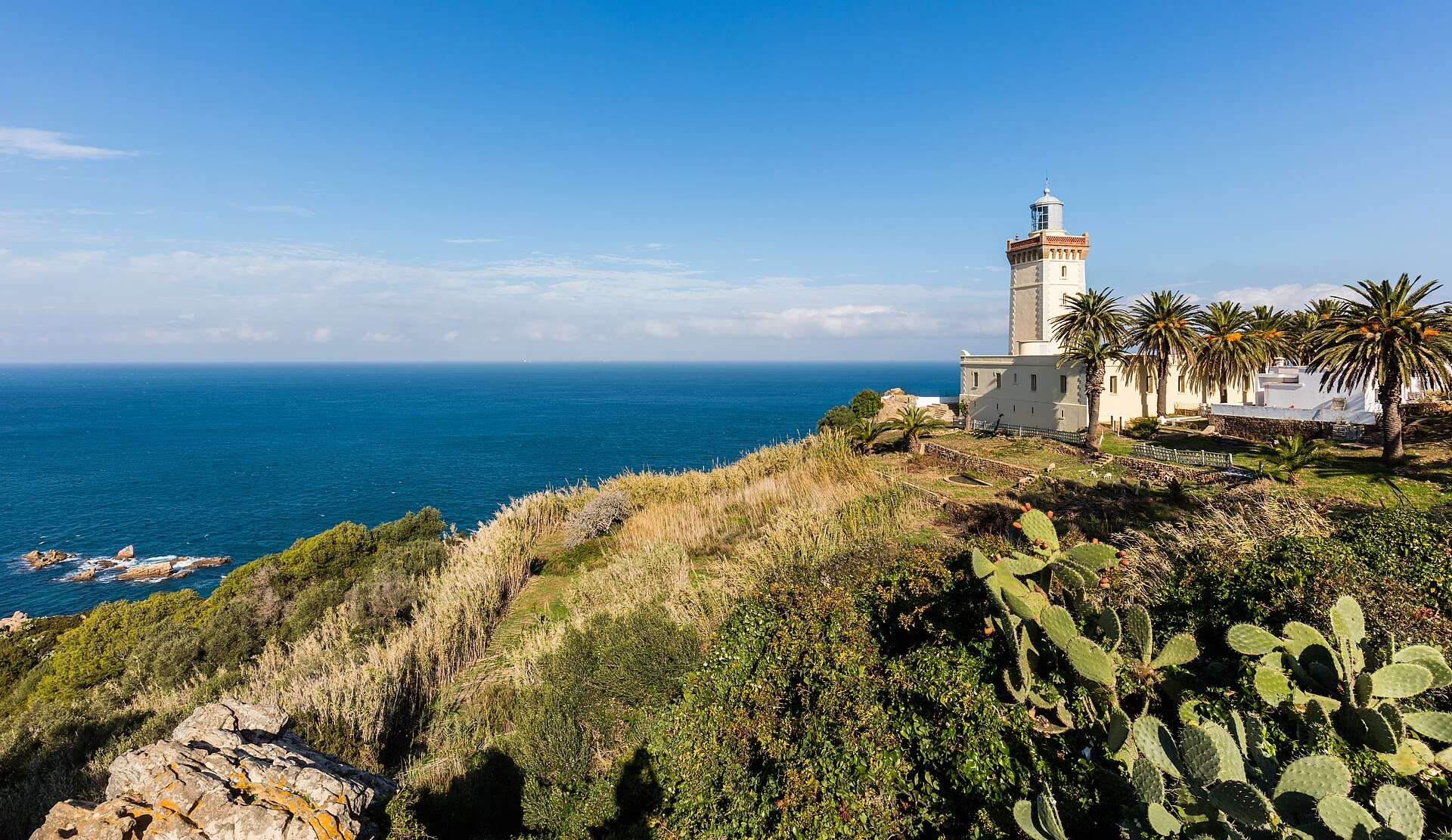
- Cape Spartel and its lighthouse, where the Strait opens onto the Atlantic.
- A little further south, the Caves of Hercules.
- An Atlantic beach, with care: strong currents and few supervised areas.
Day 3 · Day trip or new city
- Northern option: Tetouan, whose medina has been a World Heritage Site since 1997.
- Coastal option: Asilah, a walled white town on the Atlantic.
- If you stay: the Teatro Cervantes and the viewpoints along Boulevard Pasteur.
- An afternoon out to Cape Malabata, at the far end of the bay.
What to eat in Tangier
Tangier eats with a view of the sea: grilled sardines, fried fish, squid. In the morning, bissara (broad bean soup with olive oil and cumin) or msemen with honey; at lunchtime, tagine or kefta; in the evening, harira and pastries with tea. The most Tangerine flavour of all is calentita, a chickpea-flour and egg bake sold by the slice in the medina, with a name that tells of centuries of comings and goings with the other shore.
The simplest food is in the lower medina and near the port; family restaurants and patisseries are in the new city; tea with a view is in the Marshan. Alcohol is only served in licensed premises and drinking it in the street is illegal. The Spanish consulate in Tangier advises bottled water and washing fruit and vegetables thoroughly. More in customs and tipping.
Where to stay in Tangier
If you arrive on foot off the Tarifa ferry, the medina and the centre save you taxi rides; by train or car, the bay and the new city are more practical. If you are coming for the tournament, book with free cancellation: the match schedule has not yet been announced.
Budget
Guesthouses and simple riads in the medina and around the Grand Socco. Ask for recent photos and how to get there with luggage: cars cannot enter the medina.
Mid-range
Restored riads in the medina or the Kasbah, with a terrace over the Strait, or city hotels near Boulevard Pasteur.
Top end
Large hotels facing the bay and out towards Malabata, with a pool and parking, or characterful houses in the Kasbah and the Montagne.
Affiliate link: if you book through it we earn a commission, at no extra cost to you. How we are funded
Getting around and avoiding scams
Getting around Tangier
The medina and the Kasbah are explored on foot, with slopes and steps. Tangier has no tram. Petits taxis, pale blue with a yellow stripe, only operate within the city and must use the meter: driving without one is illegal. inDrive, Careem, Yango and Yassir operate here within a legal framework that is still incomplete, and the British government warns that many of these cars are unlicensed.
To travel on, see the train guide and the itinerary Tangier, Rabat and Casablanca by train; by car, driving in Morocco.
Safety and scams
Spain's Foreign Ministry considers Morocco a generally safe country and asks travellers to take care. In Tangier, the usual problems are minor: pickpockets in the medina and on the beach, and the odd self-appointed “guide” outside the port. An accredited guide carries a badge and authorisation from the local authority; if they don't show it, a polite “no, thank you” is enough. Be wary of anyone taking you to a shop “because there's a fair on today”, and never cross the Strait carrying packages for strangers.
What to avoid
- A taxi that won't switch on the meter.
- Following someone who offers to “show you the way”.
- Swimming in heavy surf on beaches without a lifeguard.
- Drinking alcohol in the street.
- Photographing military installations or flying a drone without permission.
The Grand Stadium of Tangier
- Name
- Gran Estadio de Tánger (Ibn Batouta)
- Capacity
- ≈ 75,000
- Status
- Existing
- Distance from the centre
- 4.4 km7 min by car, without traffic
The Grand Stadium of Tangier, also known as Ibn Batouta, opened in 2011 and was renovated between 2023 and 2025, gaining a 55,000 m² roof. It reopened on 14 November 2025 with Morocco v Mozambique. It holds around 75,000 people (other sources say 75,500 or 75,600).
It stands on the Avenue des Forces Armées Royales, 4.4 km from the centre by road: about 7 minutes by car without traffic, much longer on match days. There is no tram and no published shuttle plan for the stadium.
Tangier remains one of Morocco's six host cities for the 2030 World Cup, but in October 2026 the final list of stadiums had not been settled. The schedule and the allocation of matches by city have not yet been announced: be wary of anyone already promising a specific match here.
The match schedule has not been published yet. When it is announced, we will cover it here without speculation.
Getting there from Spain
By air
Ibn Battouta airport (TNG) has direct flights with Ryanair from Barcelona, Madrid, Málaga, Seville and Valencia; Iberia from Madrid; Vueling from Barcelona; Air Arabia from Barcelona, Bilbao, Madrid and, in season, Girona; Royal Air Maroc from Barcelona and Madrid in season; and Binter from Gran Canaria, also seasonal (data from November 2026).
Routes change with the season: check that your flight is direct on your dates. To compare boat and plane, see Crossing the Strait.
Frequently asked questions
What is there to do in Tangier?
The medina and the Petit Socco, the Kasbah and its museum, the Grand Socco and the Mendoubia, Cape Spartel and the Caves of Hercules. With an extra day, Tetouan or Asilah.
How many days do you need in Tangier?
One day for the medina and the Kasbah, two to add the Atlantic coast and three with a day trip to Tetouan or Asilah.
How do you get to Tangier from Spain?
By ferry from Tarifa to Tangier City (one hour) or from Algeciras to Tanger Med (1 h 30). By air, with direct flights from Madrid, Barcelona, Málaga, Seville and other cities depending on the season.
Where is the Tangier stadium and which matches will it host?
4.4 km from the centre, about 7 minutes by car without traffic, with around 75,000 seats. The match schedule has not yet been announced.
What is the weather like in Tangier in June and July?
Mild: the airport normals (1961-1990) give 16.2 to 24.9 °C in June and 18.7 to 28.3 °C in July. Heatwaves do happen: on 1 July 2026 more than nine cities in the country went above 40 °C. More in weather in June and July.
Sources (7)
Every fact on this page comes from a source consulted on the date shown.
- Hespress · después de 2026, Marruecos toma el relevo (julio de 2026) (press), 2026-11-12
- Royal Air Maroc · vuelos a España, 2026-11-12
- Seat61 · train travel in Morocco (press), 2026-11-12
- OSRM (OpenStreetMap), cálculo del 12-11-2026, 2026-11-12
- Wikipedia · List of World Heritage Sites in Morocco (press), 2026-11-12
- Wikipedia · Tangier Ibn Battouta Airport (press), 2026-11-12
- Visit Morocco · Tánger, 2026-11-12